Senior pet care in Oldwick, NJ
Exams every six months and yearly blood work, so kidney disease, thyroid disease and arthritis are found early and your older dog or cat stays comfortable for longer.
Care that keeps pace with an aging pet
Oldwick Animal Hospital cares for older dogs and cats from Oldwick and across Tewksbury Township, and the senior years are when regular care pays off most. The American Animal Hospital Association (AAHA) defines a senior dog as one in the last 25% of its expected lifespan, and a senior cat as one over 10. Arthritis, diabetes and dental disease all become more likely with age, and kidney disease becomes common in older cats. Veterinarians are taught that old age is not a disease: much of what slows a senior pet down can be found, treated and managed.
For healthy seniors we recommend a wellness exam every six months rather than once a year, with a complete physical at every visit. Annual wellness blood work builds a baseline of what is normal for your pet and catches kidney disease, thyroid disease, diabetes, Cushing's disease, infections and liver disease earlier. Routine samples go to an outside reference laboratory; when your pet is sick or the case is urgent, we run tests in-house. Our on-site pharmacy carries prescription diets, and integrative options such as acupuncture are available alongside conventional care.
Oldwick Animal Hospital offers senior care for dogs and cats in Oldwick and Tewksbury Township: an exam every six months, yearly wellness blood work, prescription diets from our on-site pharmacy, integrative options such as acupuncture, and Saturday appointments three miles away at Hunterdon Hills.
- A wellness exam every six months for seniors, compared with once a year for younger adults
- A complete physical at every visit, not only at scheduled exams
- Yearly wellness blood work that catches kidney, thyroid and liver disease, diabetes, Cushing's disease and infections earlier
- Routine samples sent to an outside reference laboratory, with in-house testing when your pet is sick
- Prescription diets carried in our on-site pharmacy
Why the senior years need a closer look
Of a dog's expected lifespan is when AAHA guidelines consider a dog a senior. Cats count as seniors once they are over 10.
AAHA Senior Care GuidelinesOf the pet population is senior dogs and cats, according to AAHA. If your pet is one of them, you have plenty of company.
AAHA, 2023Of cats over age 12 showed arthritis on X-rays in one study. In cats the first signs are usually stiffness and less activity, not a limp.
Cornell Feline Health CenterOf cats over 10 have chronic kidney disease, one of the most common diseases in older cats.
Cornell Feline Health CenterOf cats over 15 have chronic kidney disease. In the early stages, it is very common for cats to show no obvious signs.
Cornell Feline Health CenterOf dogs aged 15 to 16 showed at least one sign of age-related cognitive impairment in a published study, compared with 28% of dogs aged 11 to 12.
Journal of the American Veterinary Medical Association, 2001How we care for older pets
Exams every six months
Seniors are seen twice a year, with a complete physical at every visit, so slow changes are caught between birthdays.
A yearly blood work baseline
Annual wellness blood work catches kidney, thyroid and liver disease, diabetes, Cushing's disease and infections earlier.
Prescription diets on site
Our on-site pharmacy carries a variety of prescription diets alongside your pet's medications and preventives.
Integrative options
Integrative options such as acupuncture are available alongside conventional senior care.
Changes to watch for in an older pet
Some changes are part of normal aging. Others are early signs of disease that are easier to treat when we see them sooner. Here is how to tell which is which.
Time to ask about moving from yearly exams to every six months. Large and giant breeds get there sooner, small breeds often later.
One of the earliest signs of kidney disease, diabetes or an overactive thyroid. Book a visit with blood work rather than waiting.
In older cats, weight loss with a hearty appetite often points to thyroid disease. Lost muscle over the back and hips is worth a check in any pet.
Trouble rising, skipping the stairs or the car, or a cat who no longer jumps onto the bed usually means joint pain, which can be managed.
Can be cognitive decline, but pain, kidney disease and thyroid disease cause the same changes. An exam sorts out which.
Often dental pain or infection, which older pets hide well. Book a visit rather than waiting for the next exam.
Can signal heart disease or another serious problem. Call us the same day.
Older pets lose ground quickly when they stop eating, drinking or passing urine. Call today rather than waiting.
What happens at a senior exam
What you have noticed
We start with your observations: appetite, thirst, weight, sleep, stairs, the litter box and any change in behavior. A short phone video of a stiff morning or a restless night helps.
A complete physical
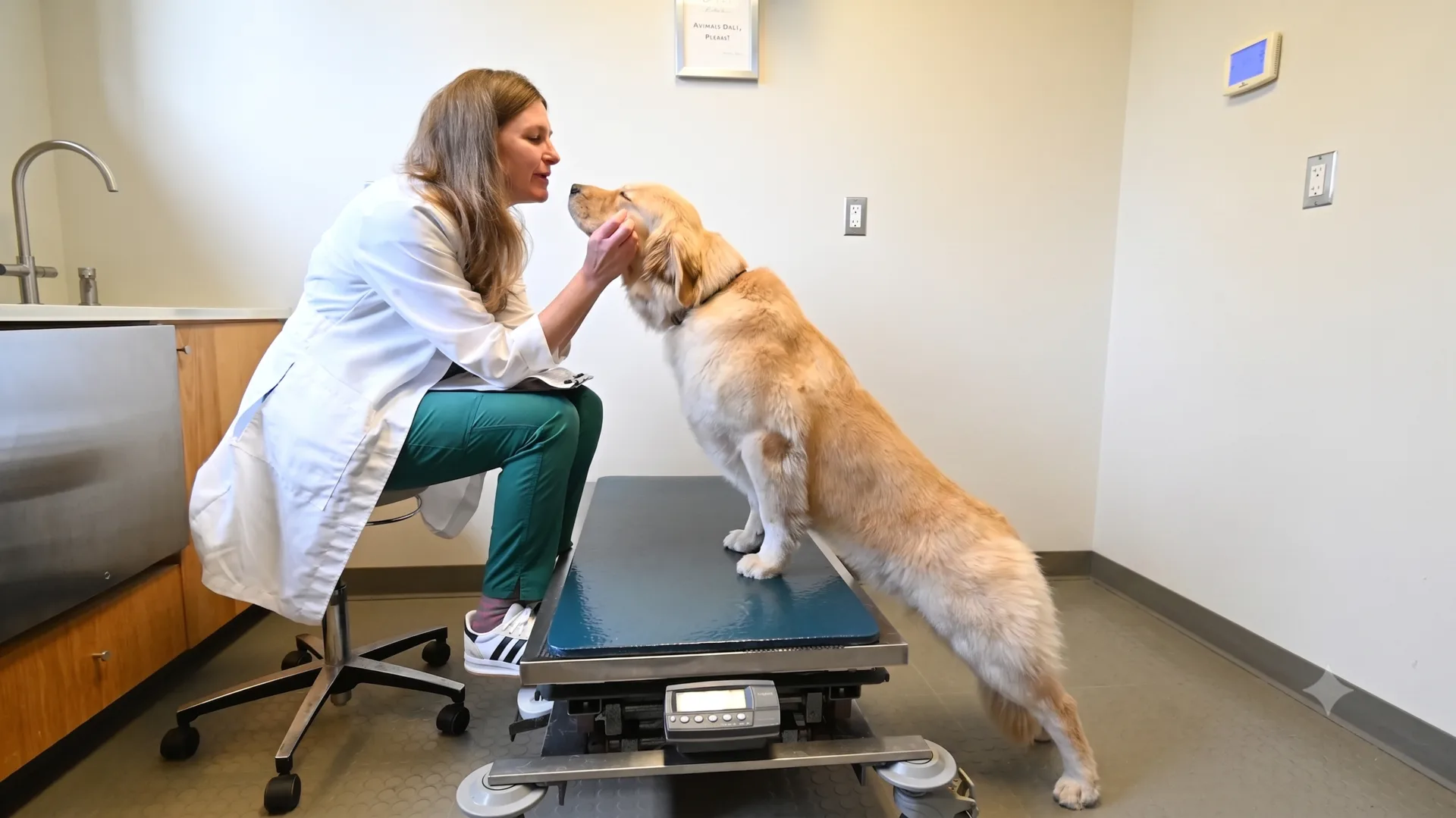
Nose to tail, with extra attention to weight and muscle, joints and gait, teeth and gums, heart and lungs, and any lumps that are new since the last visit.
Wellness blood work
Once a year we collect samples for wellness blood work, which sets a baseline and catches kidney, thyroid and liver disease earlier. Routine samples go to our outside reference laboratory; if your pet is sick, we test in-house.
A plan, and a recheck in six months
Diet, exercise, comfort and changes around the house, plus any medication or integrative care such as acupuncture, explained so you know what each part is for. We recheck in six months, or sooner if something changes, and compare each visit with the last, which is how slow changes get caught.
Samples are collected at the visit. Read more about how our laboratory services work.
Senior care for dogs and for cats
Senior dogs Senior age depends on size
Size sets the clock: AAHA notes that a large dog can be a senior at 7 or 8, while a small breed may not be until about 12. Arthritis shows as trouble rising, a stiff or swaying gait, or reluctance to jump into the car. The American College of Veterinary Surgeons calls a slender body weight the most important part of managing it.
Senior cats Senior after 10
Cats hide illness, and older cats are especially good at it. Arthritis tends to look like sleeping more, grooming less and avoiding the litter box or stairs rather than limping. Kidney disease and an overactive thyroid are both common, and both often show first as weight loss or more drinking, which is why yearly blood work matters so much for cats.
Common in both species and often mistaken for old age. Weight control and regular low-impact walks help, and treatment is planned around your pet's other health conditions.
In cats, the only known risk factor is age. Early stages rarely show signs, so blood work tends to find it first, and a diet change is usually the first step.
Senior status comes sooner, around five or six in giant breeds, so joint care and weight control start earlier too.
Night waking, getting lost in familiar rooms and new house soiling can be cognitive decline. Pain and illness come first on the list to rule out.
Making home easier for an older pet
Most of what helps an older pet happens between visits. These are simple changes that make a real difference to comfort.
Put down traction
Runners or non-slip rugs on hardwood and tile give stiff hips something to grip, especially where your pet gets up, turns or eats.
Ramps, steps and low sides
Pet steps to the bed or couch, a ramp for the car and a litter box with one low side save sore joints a jump.
A warm, supportive bed
An orthopedic bed away from drafts eases stiff joints. Older pets often look for warmth, so offer a spot or two to choose from.
Short walks, more often
Regular low-impact exercise keeps muscles strong around arthritic joints. Several short leash walks are kinder than one long weekend hike.
Watch the water bowl and the scale
Notice if the bowl empties faster or the litter clumps get bigger, and weigh your pet monthly. Both are early clues to kidney disease, thyroid disease and diabetes.
Winter: ice, salt and cold
Hunterdon County winters mean icy driveways and salted roads. The AVMA notes that cold weather may worsen arthritis and that arthritic and elderly pets are more prone to slipping on snow and ice. Shorten walks, wipe paws after outings, and keep de-icers and antifreeze out of reach.
The veterinarians caring for Oldwick's seniors
Every veterinarian on our team sees senior dogs and cats. Older pets often settle more easily with a familiar face, so feel free to ask for a particular doctor when you book.

Dr. Janisse Marie Cailles

Dr. Anna Owren Fayne

Dr. Kerry Elizabeth Scholz

Dr. Leighann Diehl
Senior care close to home
Oldwick Animal Hospital is at 130 Oldwick Road, Whitehouse Station, NJ 08889, just off Rt 78 along Rte 523/517. We care for older pets from Tewksbury, Mountainville, Cokesbury, Whitehouse Station, Lebanon, Califon, Pottersville, Far Hills, Bedminster and Readington.
Monday - Friday: 8:00 AM - 6:00 PM
Saturday: 8:00 AM - 3:00 PM (medication pick-up)
Sunday: Closed
Saturday appointments are seen at Hunterdon Hills Animal Hospital in Whitehouse Station, three miles away. The Oldwick reception desk is open Saturdays 8 AM to 3 PM for medication pick-up.
Senior pet care questions
At what age is my dog or cat a senior?
It depends on species and size. AAHA defines a senior dog as one in the last 25% of its expected lifespan, which can be 7 or 8 for a large dog and around 12 for a small breed. Cats are seniors after age 10. That is when we move from yearly exams to every six months.
Why does my senior pet need an exam every six months?
Older pets change faster, and many age-related diseases are silent at first. Cornell's Feline Health Center notes that cats in the early stages of kidney disease usually show no obvious signs. Seeing your pet twice a year lets us compare weight, muscle and joints with the last visit and act while a problem is small.
Is my pet just slowing down, or in pain?
It is often pain. AAHA notes that chronic pain from arthritis or dental disease is common in senior pets, and that many show only subtle signs such as a change in personality or habits. Trouble rising, skipping the stairs or no longer jumping into the car is worth an exam, because joint pain can be managed.
What are the signs of arthritis in cats?
The signs are usually subtle. Cornell's Feline Health Center lists sleeping more in warm spots, trouble getting in and out of the litter box, avoiding stairs and grooming less thoroughly. In one study, 90% of cats over 12 showed arthritis on X-rays, so if your older cat has stopped jumping up, it is worth an exam.
Should my senior pet's diet change?
Often, but the right diet depends on your pet's health, not just age. AAHA advises asking your veterinarian for a diet that fits your pet's life stage and any conditions. For cats with kidney disease, Cornell calls diet change an important and proven part of treatment. Our on-site pharmacy carries prescription diets. Switch foods gradually.
My older pet sleeps all day and wanders at night. Is that dementia?
It may be cognitive dysfunction, which resembles dementia in people. In a published study, 28% of dogs aged 11 to 12 and 68% aged 15 to 16 showed at least one sign. Pain, kidney disease and thyroid disease can look the same, so an exam comes first. Once those are ruled out, there are ways to help.
What are the early signs of kidney disease?
Drinking and urinating more are usually first, followed by weight loss, a poorer appetite and an unkempt coat. In the earliest stages there may be no signs at all, and Cornell reports kidney disease in up to 40% of cats over 10. Yearly wellness blood work catches it earlier, while there is more we can do.
How can I make my home easier for an older pet?
Start with traction and access: non-slip rugs on smooth floors, steps or a ramp to favorite spots, and a low-sided litter box. For pets losing sight or hearing, AAHA suggests brighter lighting, clear walkways and a gate at the top of the stairs. Keep food, water and bedding on the floor your pet uses most.
More care for older pets
Part of the Symbios network
A family of 6 neighborhood animal hospitals across New Jersey, every one 100% independently and family owned. Each is rooted in its own community and run by its own doctors and front desk team, with colleagues across the family comparing notes behind the scenes. Specialists, extended weekend hours, and shared records are all just down the road.
The personal touch of your neighborhood hospital, with a whole family of doctors behind it.
Ready to book a senior exam?
Call or text us, or request an appointment through the pet portal. Bring a list of what you have noticed at home, and any medications or supplements your pet takes.